On Evergreen Days
In the distance falling and rising mountains, covered with woods like waves in an ocean of time. Spruce trees swaying, branches shifting. A tree chosen for its tempo. A species rapidly adapting to its own relentless pace.
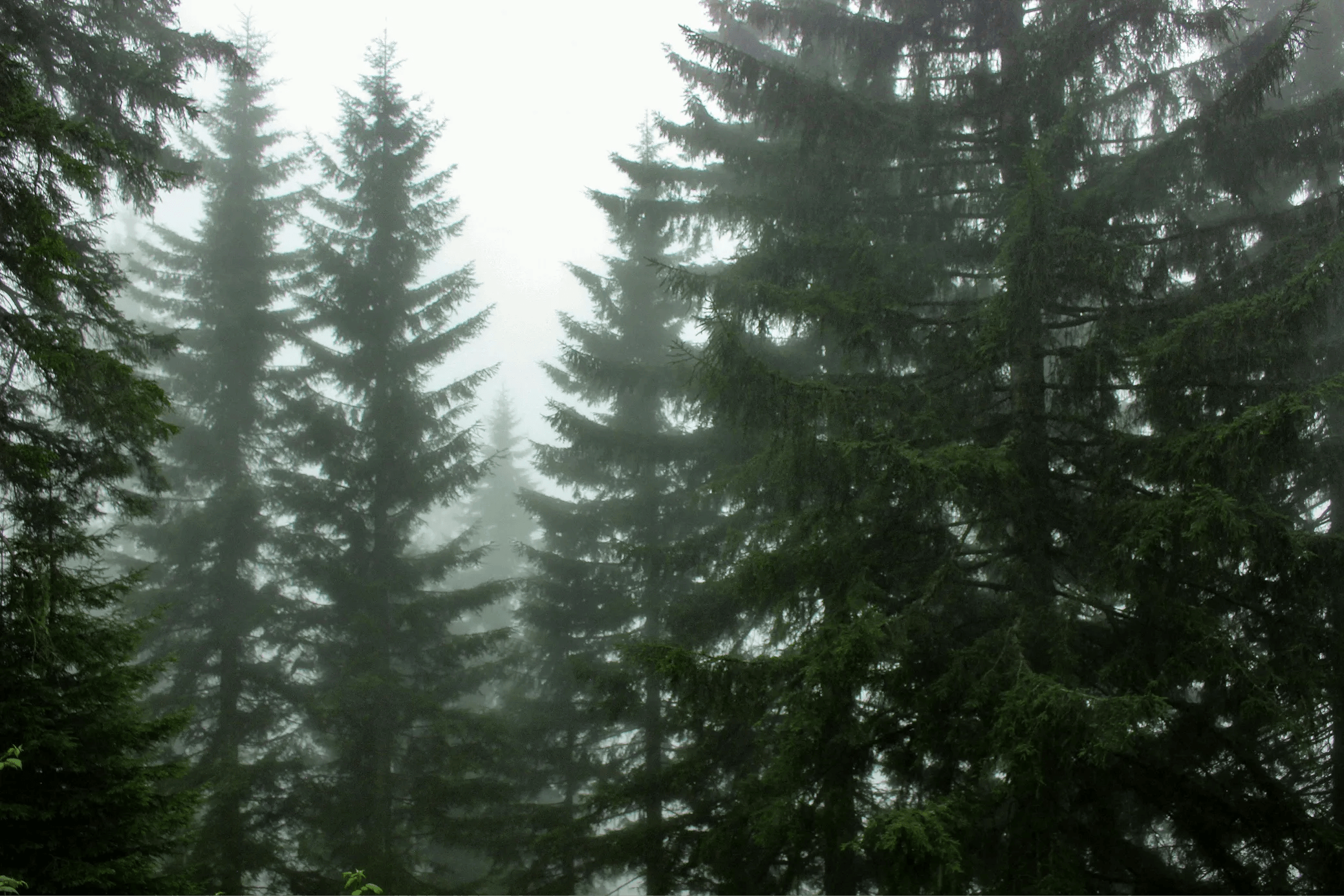
I pause beneath spruce trees. Wind sweeps through their dark green branches. Canopy to ground, leaves rustle and hiss with a single layer of sound. All the trees here appear to be the same, one species, all roughly of one age, precisely aligned and evenly spaced. The ground beneath their canopies is clean, scarcely covered with needles. No fallen trees, no decay, time practically frozen over.
The trees I stand beneath are part of the Black Forest. A large contiguous low mountain range, densely covered with woods in southwest Germany, running parallel with the Rhine. Here I have gathered countless memories of days spent among the trees and hiking with my family, as Freudenstadt, a village in the Black Forest, was the home of my great-aunt.
The region was once covered with primeval forests and later turned into spruce monocultures following extensive deforestation. My initial perception of the Black Forest was romanticized, and I long perceived the forest as ancient, dominated naturally by spruce and fir trees. However, this projected image crumbled as I began peering into the histories of the forest, attempting to trace the multitude of stories and relations surrounding each other, encountering different narratives, especially while walking through an area of the forest once disturbed by hurricane Lothar in 1999. The storm tore large gaps into the forest, uprooting millions of spruce monocultures, prone to windthrow due to their shallow roots.
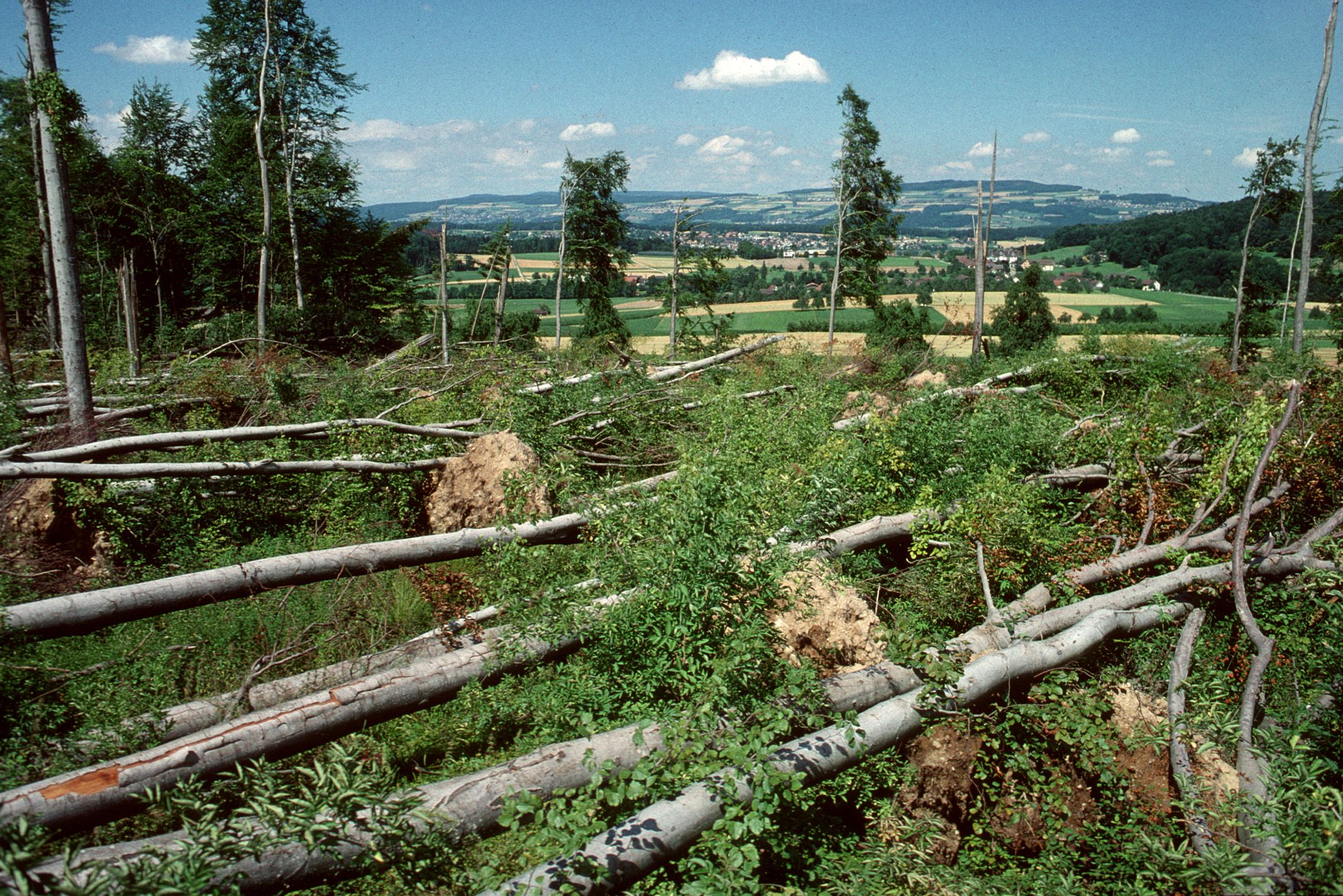
Fallen trees after the wake of cyclone Lothar
As a result of the decision to leave the storm-impacted area devoid of direct human activity such as clearing the forest floor or replanting the lost monocultures, a regrowing forest can be witnessed there. In contrast to the evenly spaced monocultures, pioneer trees like rowanberry and birch have found their way here. Bare, decaying tree stumps stand quietly. Fallen trees form habitats for insects. Mushrooms hint at the busy mycelial structures underground, forming a rich, changing tapestry.
In the Black Forest, people's relationship with the woods has ranged from its deep admiration to its exploitation, with multiple shades in between. After the first permanent settlements were established one thousand years ago, activities of humans altered the forest landscape. Plateaus were cleared, grazing intensified and wood was harvested for building and heating (Der Wildnispfad, n.d.). During the eighteenth century, the trees of the forest underwent extensive clear-cutting for charcoal burning, glass blowing and rafting, followed by another wave of clear cutting after the second world war (ibid.). The trees were commodified by the timber industry, serving as natural capital. The forests melted away like snow in sunlight. Each tree was valued for its timber far more than its place within the forest ecosystem. However, it’s not the act of conscious taking that destabilizes forests, but the rate at which we take.
“The forests melted away like snow in sunlight.
The forests have been intensively reforested for around two hundred and fifty years, but their structure is not comparable to that of the past. The trees making up the forest were gradually turned into a plantation: Mostly spruce trees with their needle-laden branches dominate its structure, chosen and preferred for their fast growth (ibid.). Now they struggle to survive increasing periods of drought and heat.
While this story is situated in the Black Forest, it echoes the all too familiar Western history of progress and industrialization through which we have come to find ourselves in the present moment. A narrative sharply observed and characterised by social anthropologist Tim Ingold as "the idea of history as consisting in the human transformation of nature" and "society as an entity counterposed to nature” (Ingold, 2000).
We are used to stories focusing on people acting and transforming their surroundings, other voices banished to the background. Such a narrative structure has had obvious detrimental effects, evident in how large-scale systems of commodification through capital continue to treat the living world and fuel the accelerating climate catastrophe. Yet, as Anna Tsing has carefully observed, "each organism changes everyone's world" and humans are far from being the only "great transformers" on earth (Tsing, 2015). My aim is not to dilute the destruction and loss of habitat caused by deforestation and large-scale forestry, but to recognize the Black Forest not simply as a backdrop for human activity, but as a space of tangled relations. The trees of the Black Forest have been planted by human design, yet storms like Lothar reveal the fragility of such designs and expose how human activity of all kinds interacts with small and large-scale ecological processes. The trees were not simply placed, they also grew, making matter with light and air, water and minerals. The interdependence of all living things becomes evident. With a disproportionate focus on people's interests, however, large-scale designed systems can conceal such interdependencies in order to continually give the impression that taking too much is exactly the right amount. That removing or reducing something does not change its process. The connections are cut as if they contain nothing.
From the perspective of an ecosystem, however, humans and their designs are always firmly joined by and with all other organisms. Ecosystems are filled with mingling matter. An ecological approach to making and telling stories might speak to just those connections and processes, trying to trace stories that emphasise relations rather than independent characters.
How could I engage in such an ecological mode of storytelling and what could it look like?
Something moves at the edge of my vision. I turn and face the flaky trunk of a spruce tree which just dropped a cone on the forest floor. How did we manage to almost alienate our consciousness from its mossy dark places, its affinity to every other living thing? From one among many to one of the only ones that seem to matter?
Noticing [Field Notes]
References
Ingold, T. (2022). The Perception of the Environment: Essays on Livelihood, Dwelling and
Skill. Routledge.
Tsing, A. L. (2015). The Mushroom at the End of the World: On the Possibility of Life in
Capitalist Ruins. Princeton University Press.
Other sources
Der Wildnispfad. (n.d.). Nationalpark Schwarzwald.
https://www.nationalpark-schwarzwald.de/nationalpark/natur/waldgeschichte
This text is an excerpt from Hammerschmidt’s master's thesis written as part of the Situated Design master’s program at the St. Joost School of Art and Design of the Avans University of Applied Sciences’ Hertogenbosch in the Netherlands.
Keep Exploring
Resonance Field
- Constance Chester
- Event Reflection
As Trees Go By
- Ulla Taipale
- Essay
Learning to live with forest (again)
- Anna Maria Fink
- Research